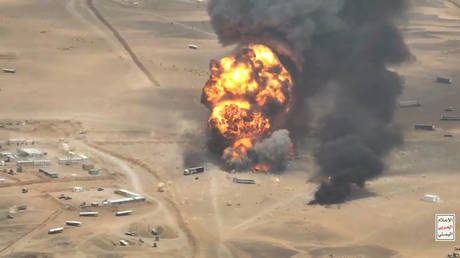
Control over maritime trade infrastructure relies less on absolute physical dominance than on the asymmetrical ability to impose prohibitive cost functions on commercial transit. The seizure of the port city of Mocha by Houthi forces along Yemen's western coast represents a structural shift in the security architecture of the Bab el-Mandeb Strait. By advancing toward this nineteen-mile-wide maritime corridor, military operations have transitioned from sporadic interdiction to systematic territorial consolidation, directly altering the risk calculations governing international supply chains.
The Geography of Maritime Asymmetry
The strategic value of the Bab el-Mandeb Strait stems from its function as the primary southern bottleneck connecting the Indian Ocean to the Red Sea and the Suez Canal. Approximately ten percent of global petroleum and refined product flows, alongside billions of dollars in manufactured goods, transit this corridor daily. Traditional naval defense doctrines assume that maritime chokepoints can be secured via blue-water power projection. However, modern littoral warfare upends this assumption.
Control of high ground and coastal enclaves like Mocha allows non-state actors to deploy low-cost anti-ship missiles, uncrewed surface vessels, and loitering munitions directly into primary shipping lanes. The operational math favors the attacker. A missile battery costing tens of thousands of dollars forces commercial operators and naval coalitions to expend multi-million-dollar interceptors or accept catastrophic hull-loss risks. Capturing Mocha removes the physical buffer that previously protected the southern approaches to the strait, shortening engagement timelines for shore-based strike assets and rendering traditional escort models increasingly reactive.
The Conflict Economy and Bargaining Leverage
Military maneuvers in Yemen operate within a distinct conflict economy where physical violence and territorial acquisition serve as instruments for extracting political and financial concessions. Rather than pursuing traditional governance outcomes, the operational strategy relies on converting localized military gains into regional leverage.
- Cost Imposition on Regional Energy Infrastructure: Direct strikes on Saudi energy assets and domestic logistics corridors compound the economic pressure experienced by neighboring states.
- Disruption of Global Transit Fee Revenues: Prolonged instability degrades throughput across the Suez-Red Sea axis, diverting traffic around the Cape of Good Hope and inflating global freight rates.
- Coercive Diplomatic Positioning: Territorial control along the coastline establishes an unignorable veto over future security arrangements, ensuring that any durable settlement must account for autonomous non-state military infrastructure.
This dynamic explains why localized ground offensives persist despite heavy tactical attrition. The objective is not merely territorial administration, but the institutionalization of permanent strategic leverage over international trade arteries.
Strategic Vulnerabilities of the Coalition Response
The military architecture opposing the Houthi advance faces a structural coordination crisis. Internationally recognized government forces, supported by regional coalitions, are constrained by fragmented command structures and defensive postures. When coalition forces execute tactical retreats—such as the recent reorganization south of Mocha—they surrender critical depth, allowing advancing units to emplace permanent coastal defense networks.
Furthermore, international naval coalitions face diminishing returns in deterrence. While defensive sweeps can intercept incoming projectiles, they do not alter the adversary's capability to regenerate launcher inventories via clandestine supply lines. Air campaigns targeting ballistic missile caches inflict structural damage but fail to dislodge entrenched infantry operating within urban and coastal civilian environments. This asymmetry creates a persistent strategic stalemate where defensive success merely maintains the status quo while offensive gains permanently alter regional control maps.
Downstream Shockwaves on Global Supply Chains
The consolidation of the Red Sea coastline cascades directly into international commodity markets. When maritime insurance underwriters factor in heightened hull-loss probabilities, premium spikes operate as an immediate tax on global trade. Shippers faced with recurrent closures or high-threat environments divert vessels away from the Mediterranean route entirely, adding thousands of nautical miles and weeks of transit time to Asia-Europe voyages.
This rerouting mechanism strains global bunkering capacities, absorbs available container ship slack, and introduces inflationary friction across manufacturing supply chains. Energy markets register these shifts instantly; Brent crude benchmarks regularly reprice upward in response to verified chokepoint escalations as traders price in the physical vulnerability of Middle Eastern export routes.
Operational Forecast
Future security in the Bab el-Mandeb sector depends on whether regional actors can transition from reactive interception to systemic counter-littoral denial. If coastal strongholds like Mocha remain under Houthi control, the corridor transitions from an international transit zone to a managed toll zone, where commercial passage is implicitly conditioned on geopolitical acquiescence. Strategic planners must abandon models assuming permanent freedom of navigation and instead prepare for an operating environment where permanent maritime friction is priced into every ocean-going supply chain.