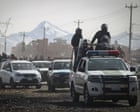
Bolivia’s first conservative administration in two decades faces an existential bottleneck that standard political narratives mischaracterize as a simple civil disturbance. When President Rodrigo Paz declared a 90-day nationwide state of emergency, deploying military personnel and heavy machinery to dismantle over forty major highway blockades, the executive branch was not merely responding to civil unrest. It was attempting to forcibly resolve a compounding structural failure where fiscal austerity, institutional dualism, and macroeconomic starvation converged to paralyze the nation.
The 50-day blockade strategy executed by rural unions, indigenous groups, and coca farmers has choked the logistical conduits connecting Bolivia's agricultural and administrative centers. By cutting off La Paz, El Alto, and the eastern lowlands, the protest movement weaponized the country’s unique topographic and infrastructure vulnerabilities. Understanding this crisis requires moving past the superficial optics of street battles to map the underlying economic and constitutional variables driving the state's kinetic intervention. For a different view, see: this related article.
The Macroeconomic Cost Function
The immediate catalyst for the destabilization was an aggressive fiscal adjustment pattern. The executive branch moved to abruptly terminate long-standing fuel subsidies in an effort to close a widening fiscal deficit. This decision was accelerated by acute shortages of US dollars and concurrent structural adjustment negotiations with the International Monetary Fund.
In highly subsidized, import-reliant developing economies, the sudden removal of fuel price floors triggers an immediate inflationary transmission vector. The economic mechanics operate across three distinct pressure points: Further reporting regarding this has been shared by Associated Press.
- The Logistical Supply Choke: Road blockades exploit Bolivia’s low infrastructure redundancy. By severing a few primary arterial highways, particularly around the central hub of Cochabamba, rural associations isolated major consumer markets from domestic food production zones and fuel distribution nodes.
- The Dollar Crunch Multiplier: The scarcity of foreign exchange reserves prevents both the state and private importers from sourcing alternative supply lines. The resulting scarcity functions as a tax on basic consumption, driving geometric price increases in food and medicine.
- The Revenue Deficit Loop: The 50-day disruption has cost the economy billions of dollars in lost productivity and stranded commerce. This drop in economic output shrinks the tax base, neutralizing the exact fiscal savings the government sought to achieve by cutting the fuel subsidies in the first place.
While the administration attempted a tactical retreat—introducing selective measures to stabilize fuel prices and rolling back controversial land distribution reforms—the concessions failed. The protest demands evolved from localized economic relief into an absolute mandate for wage increases, structural monetary fixes, and the outright resignation of the president.
Institutional Dualism and Fractured Cleavages
The current gridlock highlights a deep structural rift within Bolivia’s political economy. On one side sits a recently elected conservative executive attempting market-oriented, liberal reforms. On the other sits a powerful, highly organized network of syndicates, rural associations, and indigenous organizations that have spent twenty years operating with significant state alignment and legislative protection.
This factional architecture explains why the government’s recent deal with the main urban labor union, the Bolivian Workers' Confederation, completely failed to clear the roads. The formal urban labor agreements do not translate to the rural agrarian sectors. The rural blockades are heavily concentrated in the Chapare region, a geographic stronghold fiercely loyal to former leftist president Evo Morales.
The political strategy of the rural movement relies on a distributed command structure. Because rural associations operate independently of central urban unions, they can maintain localized blockades even when national labor bodies sign formal truces. This creates a highly resilient disruption network that is insulated from standard top-down political co-optation.
The state's response has been further complicated by the legal frameworks governing emergency powers. In May, the Bolivian Congress cleared a path for executive action by repealing a prior statutory restriction that limited the presidency's ability to issue emergency orders. This legislative shift directly removed protections previously used by labor unions to resist state security interventions.
Strategic Limits of Military Cleansing Operations
The deployment of armored units, military police, and bulldozers to clear physical blockades satisfies an immediate logistical requirement: restoring the domestic flow of goods. However, this security-first approach carries distinct institutional and operational risks that could easily backfire:
- The Sunk-Cost Barricade: Forcing protesters off a highway via kinetic measures does not eliminate the underlying grievances or the organizational capacity of the rural syndicates. The clearing of a checkpoint frequently results in the re-establishment of a new blockade further down the logistical chain.
- The Escalation Threshold: The deployment of domestic military forces increases the probability of lethal encounters. In highly cohesive indigenous and agrarian communities, state-inflicted casualties serve as powerful mobilizing events, transforming localized economic protests into widespread, unified resistance.
- The Legal and Parliamentary Clock: Under constitutional rules, the executive must notify Congress within 24 hours of declaring a state of emergency, leaving a narrow 72-hour window for legislative review. If the administration fails to build a durable coalition to validate the decree, the intervention risks losing its domestic legal backing.
The administration faces a classic asymmetric trap. While the military possesses overwhelming kinetic dominance at any single point on a highway, the decentralized protest network holds geographic ubiquity across hundreds of miles of rugged terrain.
The Imminent Operational Path
The survival of the current administration depends on an immediate, synchronized two-track execution strategy. First, security forces must establish permanent, heavily defended logistical corridors along the primary export routes rather than trying to clear every rural road at once. Concentrating resources on safeguarding the Santa Cruz-to-La Paz pipeline ensures that vital food and energy supplies continue to flow, breaking the economic blockade of the major cities.
Second, the executive branch must shift from broad union negotiations to localized, transactional bargaining with regional agrarian leaders. By uncoupling specific rural demands regarding local agricultural credits and land titles from the broader national political dispute, the administration can systematically peel away moderate factions from the hardline core. If the government relies solely on military force without addressing these local economic realties, the current clearance operations will yield nothing more than a brief, highly unstable pause in an ongoing national collapse.