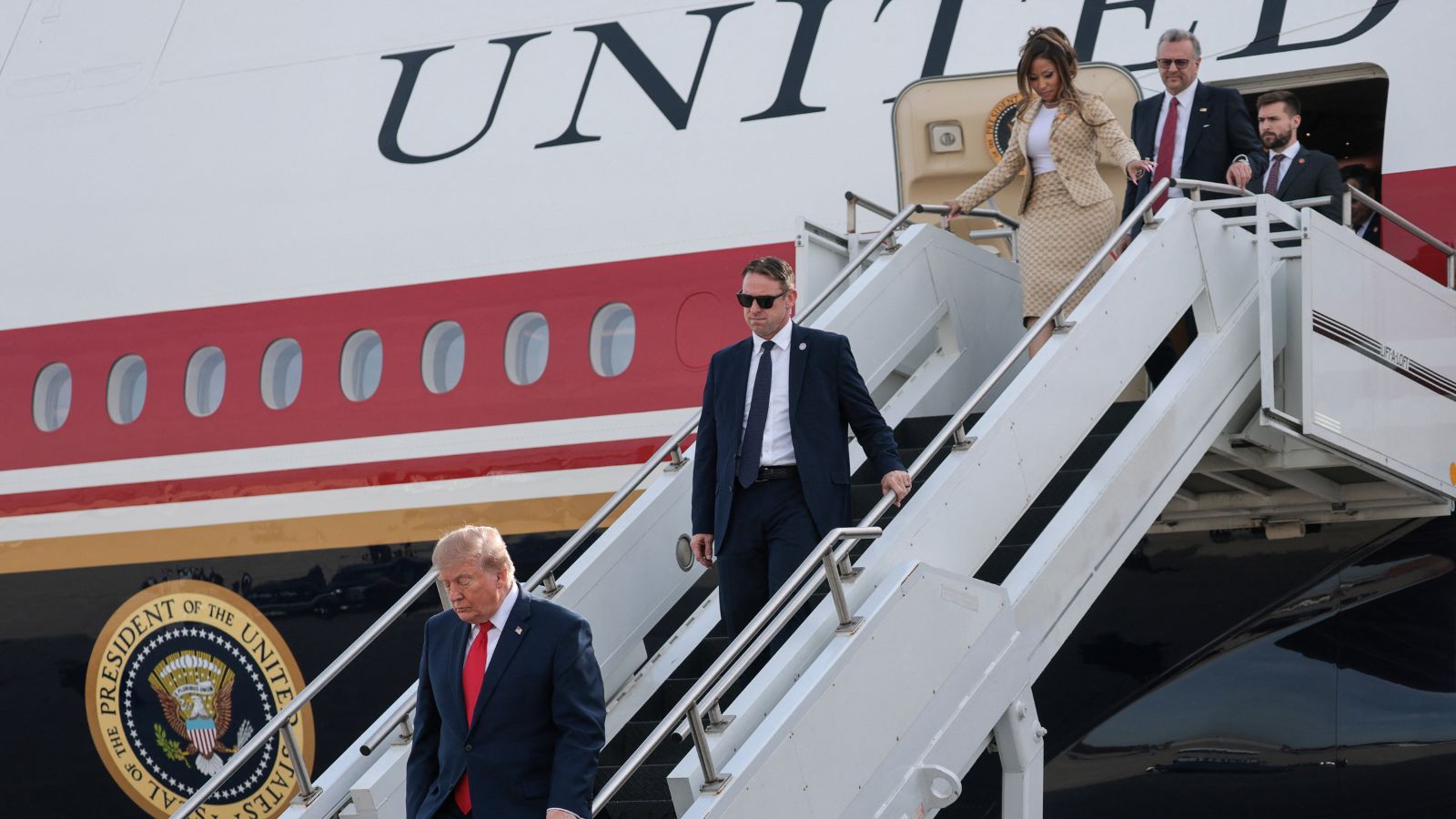
Thirty-nine thousand feet above the Atlantic, the air is thin, cold, and lethal. Inside the fuselage of the modified Boeing 747-200B, however, the climate is carefully pressurized to simulate a brisk day in Colorado, and the currency of the realm is pure, unadulterated proximity.
Access. For another perspective, read: this related article.
That single word governs every square inch of the four-thousand-square-foot flying White House. When a standard news report reduces the manifest of a presidential flight to a dry roster—noting that Donald Trump recently shared Air Force One with heavyweight boxing champions, hip-hop icon Nicki Minaj, and his innermost circle of West Wing aides—it misses the architecture of modern power entirely. A flight log is never just a list of passengers. It is a blueprint of cultural strategy, a floating stage where political gravity bends to accommodate the heavyweights of entertainment and sport.
To understand why a sitting or campaigning president invites a multi-platinum rapper and bruised prizefighters into the most secure aircraft on earth, you have to strip away the partisan noise and look at the cabin through the eyes of someone who has spent decades watching how human attention is captured, traded, and weaponized. Further analysis regarding this has been shared by Reuters.
The Architecture of a Flying Court
I have spent years covering the corridors where politics bleeds into pop culture, standing behind velvet ropes and press barricades, watching the subtle choreography of power. On the ground, influence is diffused. A politician gives a speech in an arena; an athlete wins a belt under stadium lights; a musician drops an album to millions of streaming devices. They exist in separate ecosystems, speaking to distinct tribes.
Put them inside a sealed aluminum tube hurtling at six hundred miles an hour, and the friction between those worlds vanishes.
Air Force One is uniquely engineered for this alchemy. Unlike commercial airliners divided into rigid classes of service, the presidential aircraft is a series of nested concentric circles radiating outward from the nose cone. At the very front sits the president’s private suite—an office, a bedroom, and a medical facility capable of functioning as an operating room. Just behind that lies the conference room and the senior staff cabin, where communications directors, chiefs of staff, and legislative liaisons hunch over secure terminals. Further back sits the Secret Service detail, and at the very rear, separated by heavy curtains and strict protocol, rides the traveling press corps.
When an outsider is invited past the press cabin, past the Secret Service, and into the forward conference room, a profound psychological shift occurs. Consider a hypothetical scenario to see how this works in practice: imagine a mid-level political operative who has spent six months trying to draft a policy paper that will resonate with working-class men under thirty. That operative can buy ten million dollars in targeted digital ads, and the target demographic will scroll right past them in half a second. Now, imagine that same demographic seeing a candid photograph of their favorite undefeated boxer laughing over burgers with the president at thirty-nine thousand feet, flanked by a global music superstar whose fanbase commands armies online.
The operative’s six months of data modeling just became obsolete in the time it takes to snap a shutter.
This is not an accident of hospitality. It is the deliberate construction of a royal court in the clouds. Historically, monarchs traveled with jesters, poets, and champions not merely for amusement, but to project an aura of total cultural dominance. If the strongest fighters and the loudest voices in the land are willing to sit at the ruler’s table, the subconscious message to the public is unmistakable: This is where the center of gravity lives.
The Heavyweights and the Microphone
Look closely at the specific archetypes on that manifest: boxing stars, Nicki Minaj, and top White House aides. On paper, they appear to have nothing in common. In reality, they represent the three pillars required to dominate the contemporary attention economy.
First, look at the fighters. Boxing is the most primal, unvarnished theater in professional sports. There are no teammates to blame, no clocks to run out safely, and no helmets to hide the fear in a fighter’s eyes. When Donald Trump brings championship boxers onto Air Force One, he is tapping into an ancient wellspring of masculine credibility. Long before he entered politics, Trump built a massive portion of his brand at ringside in Atlantic City, hosting Mike Tyson and Evander Holyfield, absorbing the reflected glamour and raw toughness of the sweet science.
By inviting today’s boxing elite into the presidential cabin, he bypasses traditional sports media entirely. A fighter who steps off Air Force One carries an unspoken endorsement back into the gym, onto podcasts, and into locker rooms across the country. The tacit message is simple: He respects warriors, and warriors respect him. For a political movement heavily invested in projecting strength and defiance against institutional norms, a heavyweight champion standing next to the presidential seal is worth more than a dozen endorsements from Senate committee chairs.
Then, there is Nicki Minaj.
Her presence on that guest list is the detail that makes traditional political analysts rub their temples in confusion. Why would a Trinidadian-born hip-hop titan, known for razor-sharp lyricism, theatrical alter egos, and a fiercely loyal fanbase known as the Barbz, share airspace with conservative White House aides?
To answer that, you have to understand the currency of disruption. Both Trump and Minaj built their empires by refusing to play by the polite rules of their respective industries. Both have waged relentless, public wars against gatekeepers, critics, and media establishment figures who tried to declare their careers over. When Minaj enters the orbit of Air Force One, it shatters the predictable demographic boxes that political consultants rely on. It forces millions of people who never watch cable news to suddenly pay attention to a political narrative simply because one of the most dominant figures in modern music stepped into the frame.
I remember watching a similar collision of worlds years ago at a backstage VIP lounge in New York, where an aging political titan stood awkwardly beside a platinum-selling rapper. At first, the room felt tense, almost absurd. Within ten minutes, however, the flashbulbs were going off, and the two men realized they spoke the exact same native language: the dialect of ratings, crowd size, and survival. They didn't need to agree on tax policy to recognize a fellow apex predator in the attention jungle.
The Invisible Mechanics of the Guest List
People often ask how someone actually gets invited onto Air Force One. Is there an application? A donor threshold? A formal vetting process?
The truth is far more fluid and human. While the Secret Service conducts rigorous background checks on every soul who boards the aircraft—scanning names against intelligence databases long before the manifest is finalized—the actual invitation comes down to the whims, instincts, and strategic calculations of the principal and his closest aides.
Those top White House aides on the flight list are the gatekeepers of the gatekeeper. They are the ones calculating the exact return on investment for every empty leather seat on the plane. Space on Air Force One is finite, and every seat given to a celebrity or an athlete is a seat denied to a cabinet secretary, a local congressman, or a policy advisor.
Think about the quiet tension that creates inside the West Wing. Imagine a senior domestic policy advisor who has spent three weeks preparing a briefing binder on supply-chain logistics, hoping for twenty minutes of uninterrupted airborne time with the president before they land in a swing state. She boards the plane, binder in hand, only to find the conference room already buzzing with the entourage of a world-champion boxer and a global pop icon. Her briefing gets pushed to a five-minute hallway conversation over the roar of the General Electric engines.
That is the hidden cost of celebrity politics. When the cabin becomes a studio for viral moments, the quiet, grinding machinery of governance has to step aside for the spectacle.
Yet, from a purely tactical standpoint, it is hard to argue with the aides who orchestrate these flights. Traditional political communication is dying a slow, painful death. Press releases go unread. Cable news panels preach to shrinking, hyper-partisan choirs. Even massive rallies can start to look repetitive to an audience numbed by endless scrolling.
Air Force One, by contrast, remains one of the few symbols on earth that still commands automatic awe. The baby-blue and white livery designed by Raymond Loewy during the Kennedy administration carries an almost mythic weight. When you place a figure from outside the political sphere inside that iconic frame, you create cognitive dissonance—and cognitive dissonance is the ultimate fuel for the modern algorithm. People stop scrolling because their brains are trying to reconcile two images that do not belong together: the solemnity of the American presidency and the raw, unfiltered energy of pop culture.
The Vulnerability Behind the Spectacle
It would be easy to view this entire phenomenon with pure cynicism, to dismiss it as nothing more than a reality-television president casting his next episode at thirty-nine thousand feet. And honestly, part of me still wrestles with the discomfort of it. There is a lingering nostalgia in all of us for a quieter, more dignified era of statecraft, where the presidential aircraft was a solemn sanctuary of maps, treaties, and hushed strategic debates, insulated from the noise of the boulevard.
We wonder what happens to the gravity of the office when the velvet rope of the White House merges with the VIP section of a championship fight or an awards show. When leadership is measured in viral reach and cultural crossovers, do we lose the patience required for the slow, unglamorous work of solving problems that cannot be fixed in a thirty-second clip?
It is a fair question, and there is no comfortable answer.
What we do know, however, is that the wall separating politics from entertainment did not collapse yesterday. It has been eroding since the moment John F. Kennedy stepped onto a television debate stage in 1960 looking rested and tanned beside a sweating, pale Richard Nixon. It cracked further when Bill Clinton put on sunglasses and played the saxophone on The Arsenio Hall Show, and when Barack Obama slow-jammed the news with Jimmy Fallon. Every generation of political leaders eventually realizes that if the public will no longer come to the town square to listen to speeches, the leader must go to the digital colosseum where the public already lives.
Trump simply took that historical trajectory and strapped jet engines to it. He understood earlier than almost anyone in Washington that in an era of fractured media, you cannot win by merely being a politician. You have to be an event.
The View from the Tarmac
Picture the scene at the end of the flight.
The massive 747 touches down on a rain-slicked tarmac in the middle of the night, the thrust reversers roaring like thunder as the aircraft slows to a crawl. Outside, behind rows of steel barricades and blinding banks of stadium lights, thousands of people have been standing in the cold for hours, waiting for a glimpse of the stairs rolling up to the forward hatch.
Inside the cabin, the heavy door swings open, letting in the rush of night air and the distant, muffled roar of the crowd.
First come the aides, clutching leather portfolios and glowing phones, already drafting the social media posts that will drop before the motorcade even reaches the highway. Behind them steps the president, pausing at the top of the stairs to raise a fist against the night sky. And right there in the doorway, framed by the presidential seal and the blinding strobe of a hundred cameras, stand the fighters and the superstar—smiling, waving, bathed in the reflected glow of the most powerful office in the world.
Down on the tarmac, the press corps scribbles down the names for the morning brief, treating the manifest like a mere curiosity of travel logistics. Meanwhile, across millions of glowing screens from the Bronx to rural Ohio, the image is already replicating at the speed of light—a silent, unmistakable signal that the boundaries of power have shifted once again, leaving the rest of the world standing behind the barricade, watching the door.