When an aviation ground stop strands an NFL officiating crew hours before kickoff, the league executes an emergency contingency protocol that pulls officials from an earlier game, rushes them across town or across state lines, and assigns them to work two professional football games in a single day. It is the ultimate stress test of NFL logistics, human endurance, and rulebook precision. While broadcast crews scramble to explain why a back judge looks suspiciously familiar from the 1:00 PM window, the league office in New York is quietly managing a high-stakes operational scramble designed to keep a multi-billion-dollar television schedule from grinding to a halt.
Officiating an NFL game is not a casual Sunday afternoon hobby. It is a grueling, four-hour sprint of split-second biomechanics, constant communication, and relentless scrutiny. Now double it. The sheer physical and cognitive toll of working back-to-back games in the modern National Football League pushes even the most seasoned veterans to their absolute limits, exposing the fragile logistical web that holds professional sports together every autumn.
The Anatomy of an Aviation Chokepoint
Air travel is the invisible backbone of the NFL. Unlike players and coaches, who travel on massive, tightly controlled team charters with dedicated ground transport and private tarmac access, NFL officials fly commercial. They book standard tickets through league travel portals, navigate commercial security lines, and sit in middle seats just like everyone else. Usually, they fly into the host city on Saturday afternoon, attend a mandatory crew meeting at a local airport hotel, review film of the competing teams' tendencies, and head to the stadium early Sunday morning.
That system works until the weather turns ugly or the Federal Aviation Administration issues a sudden ground stop.
A ground stop is not a standard flight delay. It is an immediate halt to all departing air traffic bound for a specific airport or region, triggered by severe thunderstorms, fog, airspace congestion, or technical outages in air traffic control systems. When a hub like Chicago O'Hare, Atlanta Hartsfield-Jackson, or Newark Liberty locks down on a Saturday night or Sunday morning, the ripple effects hit the NFL officiating roster instantly.
Because the league maintains roughly 17 full officiating crews—totaling around 120 to 125 active on-field officials—there is almost no bench sitting idle in local hotels waiting for a phone call. Every single crew is assigned to a game during peak regular-season weeks. If a crew is stuck on a tarmac in Charlotte while their Sunday assignment is kicking off in New York, the league cannot simply conjure seven fresh officials out of thin air. They have to cannibalize existing coverage.
How the Emergency Double Duty Protocol Works
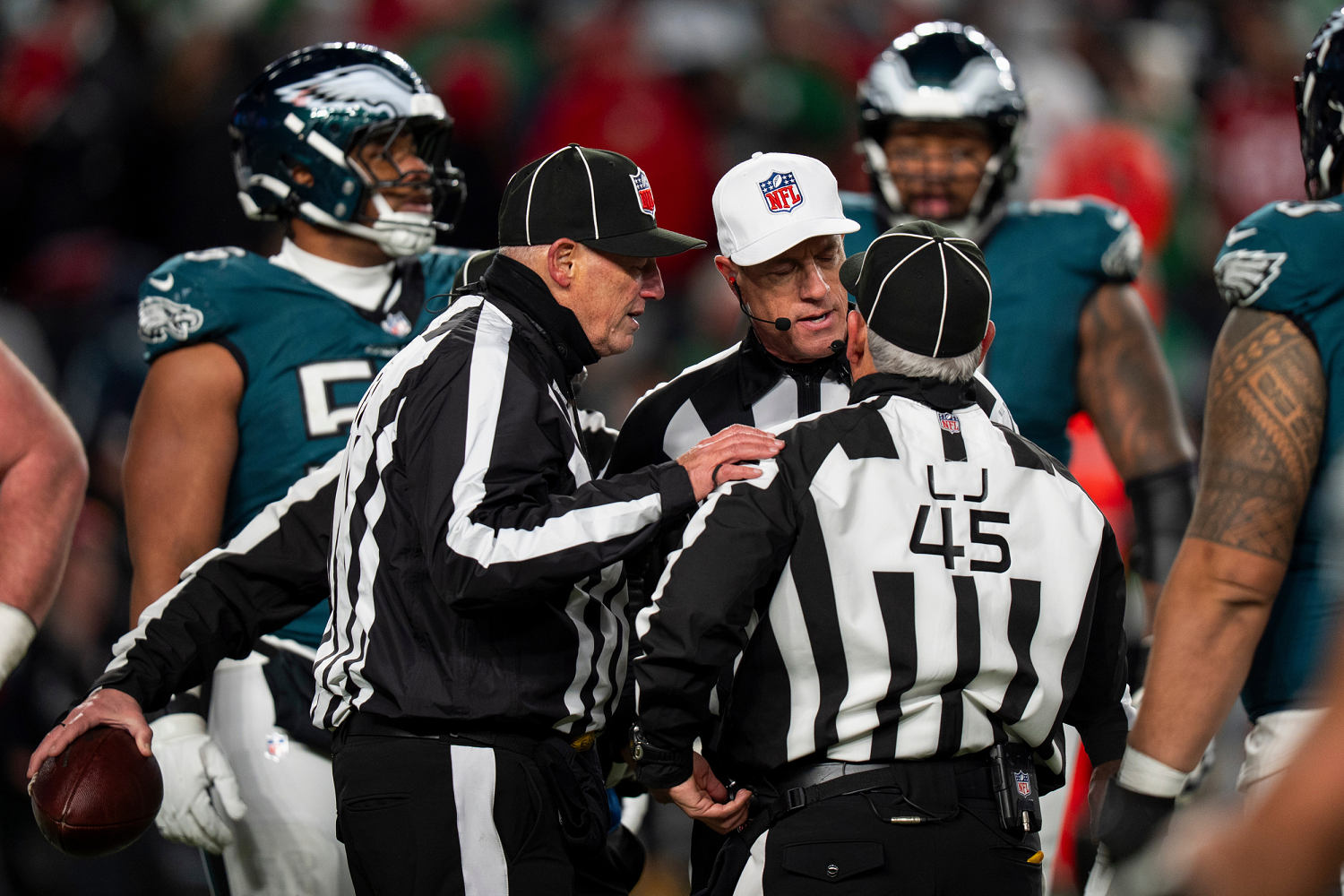
When the NFL Officiating Department realizes a crew will not make kickoff, the command center in New York—specifically the Art McNally GameDay Central room—shifts from replay review to crisis logistics. The solution almost always relies on geographic proximity and staggered kickoff times.
Consider a hypothetical scenario to see how the mechanics play out on the ground. Imagine a Sunday where the New York Jets are hosting an early game at 1:00 PM ET at MetLife Stadium, while the New York Giants are scheduled for a Sunday Night Football broadcast at 8:20 PM ET in the exact same building. Or picture a dense corridor like the Northeast, where Philadelphia, Baltimore, Washington, and New York sit within a two-hour drive or short train ride of one another. If a ground stop traps the officiating crew assigned to the late-afternoon or night game, the league looks immediately to the crews already working the 1:00 PM slate nearby.
The logistics move fast:
- Triage and Selection: League administrators identify which officials are needed. Sometimes an entire crew is stranded; other times, only two or three members—perhaps the referee, the umpire, and a side judge—were connecting through the affected hub.
- The Tap on the Shoulder: During halftime or immediately following the final whistle of the early game, a league representative informs the selected officials that their workday is only halfway over.
- Rapid Transit: As soon as the clock hits zero, those officials bypass the normal post-game shower and debrief. Local police escorts or dedicated league car services rush them from one stadium to the next, lights flashing, bypassing post-game traffic gridlock.
- Equipment and Uniform Adjustments: Officials carry backup gear, or stadium staffers scramble to launder and dry sweat-soaked striped shirts in the ninety-minute window between games.
If an entire crew cannot be relocated in time, the league assembles a hybrid crew. They might pull three officials from an early game in Baltimore, combine them with two stranded officials who managed to drive in, and patch the remaining spots with any available alternates. In extreme emergencies, the NFL has even shifted positional assignments on the fly, asking a line judge to step into a field judge role just to get a legally compliant seven-person crew on the grass.
The Invisible Toll on Human Physiology
To appreciate why double duty is considered a nightmare scenario by the officials themselves, you have to understand what happens to an official's body during a single NFL game.
Modern NFL officials are conditioned athletes, but they are not 22-year-old cornerbacks. Most are in their 40s, 50s, and early 60s. During a standard three-hour-and-fifteen-minute broadcast, a deep wing official—like a side judge or field judge—will cover between four and six miles. Much of that distance is logged running backward at high speed while keeping their head on a swivel to track a wide receiver's route stem, monitor defensive holding, and watch the sideline boundary simultaneously.
The physical output is only half the equation. Decision fatigue is the real enemy.
An NFL official processes thousands of visual micro-events per game. On every snap, an umpire standing behind the defensive line has less than two seconds to read offensive line blocking schemes, spot holding, detect illegal hands to the face, and get out of the way of a 250-pound linebacker crashing the A-gap. Multiply that cognitive load by 130 to 150 plays per game. By the fourth quarter, cortisol levels are spiked, glycogen stores are depleted, and mental acuity naturally begins to fray.
Now imagine finishing that fourth quarter, sitting in the back of a police cruiser for forty-five minutes while adrenaline crashes and lactic acid pools in your calves, eating a cold energy bar, and walking back onto a stadium field under bright primetime lights to do it all over again.
The Breakdown of Crew Chemistry
Football officiating relies heavily on non-verbal rhythm. A permanent crew spends the entire offseason on Zoom calls and all regular season in hotel conference rooms learning each other's mechanics. A referee knows precisely how fast his down judge spots the ball. A back judge knows how his side judge handles deep pass interference calls near the pylon.
When a ground stop forces a patchwork crew or exhausts a veteran unit through double duty, that rhythm vanishes. Communication over the crew's closed-loop wireless headsets becomes clunky. Two officials might hesitate on a bang-bang play near the sideline, each assuming the other has the primary angle, or worse, throw conflicting flags on the same infraction. When an officiating crew looks indecisive on national television, coaches pounce, players lose trust in the whistle, and the pace of the game slows to a crawl.
Why the NFL Refuses to Delay Kickoff
The obvious question from fans sitting on their couches is simple. Why not just delay kickoff by two hours until the original crew's plane lands?
The answer comes down to television contracts and stadium operations. The NFL is not merely a sports league; it is the most valuable live television programming on earth. Networks like CBS, Fox, NBC, and ESPN pay tens of billions of dollars for precise broadcast windows.
If a 1:00 PM game is delayed until 3:00 PM, it collides directly with the 4:25 PM national doubleheader window. Networks lose massive advertising revenue when broadcasts overlap, local affiliates revolt when evening news slots are wiped out, and millions of viewers are forced into blackout restrictions. Delaying a primetime game creates similar chaos for late-night programming and west-coast viewing habits.
Beyond the broadcast booth, delaying an NFL game triggers a massive operational cascade inside the host city. Stadium security, municipal police details, public transit schedules, unionized stadium workers, and concessionaires are all booked on strict hourly blocks. Pushing kickoff back two hours costs hundreds of thousands of dollars in overtime pay and creates severe crowd-control headaches when 70,000 fans are left loitering in parking lots and concourses.
From the league's perspective, a tired officiating crew working double duty is an acceptable operational risk. A delayed television broadcast is not.
The Structural Flaw in Officiating Logistics
Every time a ground stop forces an emergency scramble, it highlights a lingering debate inside league circles regarding how officials are employed and deployed. Despite generating upwards of twenty billion dollars in annual revenue, the NFL still classifies its on-field officials as part-time employees.
Many NFL officials hold high-powered weekday jobs. They are attorneys, financial advisors, school administrators, and business owners. Because of those weekday commitments, officials routinely book the latest possible Saturday flights to the host city so they can finish their Friday work obligations and spend Saturday morning with their families.
Flying in on Saturday afternoon leaves zero margin for error. If a blizzard hits Denver or air traffic control shuts down the Eastern Seaboard on Saturday evening, the official has no buffer day to rent a car and drive eight hours to the stadium.
Critics of the current model argue that transitioning officials to full-time status—or at least mandating Friday night arrivals in host cities—would virtually eliminate ground-stop emergencies. If every crew is already checked into the team hotel thirty-six hours before kickoff, a Sunday morning airspace closure becomes a total non-issue.
The NFL Referees Association, the union representing the officials, has historically pushed back against full-time mandates unless the compensation matches the sacrifice of giving up lucrative outside careers. Meanwhile, the league office has shown little appetite for paying full-time executive salaries and year-round benefits to 125 officials just to insure against weather delays that happen once or twice a season.
The Alternate Official Dilemma
Another structural weakness exposed by travel disruptions is the league's lean roster of alternate officials. In recent years, the NFL has utilized swing officials—experienced referees or umpires who travel to high-profile games (especially during the playoffs) to serve as immediate on-site backups in case someone pulls a hamstring or suffers a concussion during the game.
During the regular season, however, putting a dedicated standby official in every single NFL city every weekend is considered cost-prohibitive. The league keeps a small pool of alternates on call, usually stationed near major airline hubs, ready to jump on a flight if an official falls ill on Friday. When an airspace ground stop happens, those hub-based alternates are grounded right alongside everyone else.
What Happens on the Field When Fatigue Sets In
When an officiating crew steps onto the field for their second game of the day, the strategic dynamic between the stripes and the sidelines shifts subtly. Veteran NFL head coaches know everything. The moment a coach sees an official who just worked the early slate in another city, that information goes straight into the headset.
Smart coaches adjust their tactics accordingly:
- Testing the Perimeter: Offenses will frequently attack the deep boundaries early in the game, testing whether a fatigued field judge or side judge can keep up with a vertical passing game.
- Increasing Tempo: Running a no-huddle, up-tempo offense forces the umpire and down judge to sprint constantly between plays to spot the ball. If an official is lagging behind the play, the defense cannot substitute, or the offense forces a sloppy spot.
- Working the Officials: Coaches become noticeably more vocal on borderline holding or pass interference calls, subtly planting seeds of doubt in the minds of officials whose mental bandwidth is already stretched thin.
Interestingly, statistical anomalies often swing in unexpected directions during emergency double-duty games. Rather than throwing flags on every snap, exhausted crews frequently swallow their whistles. When the brain is fighting fatigue, officials tend to default to letting borderline contact go unless it is undeniably egregious. While fans often cheer fewer penalties, offensive and defensive linemen quickly recognize when the whistle has tightened up, leading to noticeably more physical—and occasionally chippy—play in the trenches.
The league's replay center in New York does its best to provide a safety net during these situations. When Art McNally GameDay Central knows a crew is working on fumes, replay officials monitor routine plays with heightened vigilance, ready to buzz down for expedited reviews on catches, fumbles, and boundary rulings to take pressure off the exhausted eyes on the grass.
The Thin Margin Between Order and Chaos
The modern NFL presents itself as an unstoppable, precision-engineered entertainment juggernaut. Every camera angle is choreographed, every commercial break is timed to the millisecond, and every rulebook interpretation is dissected by former officials sitting in network broadcast booths.
Yet beneath that polished exterior, the entire Sunday operation still depends on seven human beings catching commercial flights on time. A thunderstorm over Dallas or a radar glitch in Virginia can instantly unravel months of scheduling, forcing middle-aged men to sprint through airport terminals, ride in the back of state trooper cruisers, and officiate 300 snaps of violent, high-speed football before midnight. The system survives not because the logistics are foolproof, but because a small fraternity of stubborn professionals refuses to let the clock stop running.