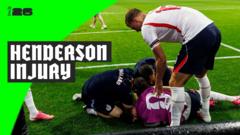
The media collective just found its latest piece of low-hanging fruit. Dean Henderson trips during a post-match celebration, hurts his wrist, and the predictable wave of scolding articles follows. Out come the finger-wagging pundits, the pearl-wringing columns, and the risk-assessment experts lamenting the "unnecessary danger" of professional athletes losing their minds for ninety seconds after a massive win.
They call it a freak accident. They call it unprofessional. They call it a preventable tragedy that costs clubs millions in asset value.
They are completely wrong.
The panic over celebration injuries exposes a fundamental misunderstanding of elite human performance. We have created a sports culture obsessed with wrapping human beings in bubble wrap, treating world-class competitors like fragile tech stocks that might crash if they sneeze too hard. The narrative demanding that players restrain themselves, celebrate with a polite golf clap, and walk quietly back to the dressing room is not just sterile. It is actively detrimental to the very mechanics that make these athletes elite in the first place.
Stop asking players to turn off the adrenaline the exact millisecond the final whistle blows. It is neurologically impossible, and trying to force it ruins the sport.
The Adrenaline Debt Cannot Be Defaulted On
Football at the highest level is not a corporate simulation. It is a controlled state of hyper-aggression, hyper-focus, and extreme physiological stress. For ninety minutes, a player’s sympathetic nervous system is redlining. Cortisol and adrenaline are pumping at levels that would make an ordinary office worker feel like they are having a medical emergency.
When that pressure valve suddenly releases, the human body undergoes a massive chemical purge. The post-match celebration is not a choreographed marketing stunt; it is a bio-behavioral necessity.
- The Cortisol Crash: Forcing an athlete to instantly suppress the euphoria of a win creates an artificial emotional bottleneck.
- The Proprioception Shift: When adrenaline spikes, pain thresholds skyrocket and spatial awareness alters. Expecting a player to have perfect, sterile footing while sprinting toward a traveling fan base is a failure to understand basic human biology.
- The Stress Release: Joy is a performance metric. The psychological recovery from a grueling match begins with the collective release of tension shared with teammates and supporters.
When you demand that a player like Henderson "carefully" navigate the pitch after a high-stakes victory, you are asking them to override millions of years of evolutionary biology. The body needs the dump. The mind needs the high. Trying to sanitize that moment to protect an insurance policy is a losing strategy.
The Financial Fallacy of the Bubble-Wrap Contract
The corporate suits running modern football clubs view players strictly as capital expenditures. They look at a multi-million-pound asset tripping over a advertising board or a teammate's leg and they see a spreadsheet error. They want clauses in contracts. They want fines for excessive sliding, bans on backflips, and mandatory cooling-off periods.
I have watched sporting directors spend hundreds of thousands of pounds on cryotherapy chambers, load-monitoring GPS vests, and sleep tracking rings, only to turn around and freak out when a player pulls a hamstring doing a knee slide.
Here is the cold truth those directors refuse to face: you cannot cultivate a mindset willing to throw its body in front of a traveling ball at seventy miles per hour, and then expect that same mindset to be cautious when the whistle blows. The two states of being are fundamentally linked.
If you strip away the raw, unhinged emotion that drives the celebration, you simultaneously erode the competitive edge required to win the match in the first place. You cannot have a warrior on the pitch and a risk-averse accountant during the celebration. You buy the whole package, or you buy mediocrity.
Dismantling the People Also Ask Nonsense
Whenever an injury like this happens, the internet algorithms choke on the same tired queries. Let us address them with zero corporate fluff.
Should clubs fine players for celebration injuries?
Absolutely not. Fining a player for getting hurt while expressing genuine passion for winning your football club three points is the fastest way to lose a dressing room. The moment a squad perceives that management cares more about minimizing physical liability than celebrating victory, team chemistry dies. You destroy the intangible culture of the club to protect a few weeks of squad depth. It is a terrible financial trade-off.
Can you train athletes to celebrate safely?
The very question is an insult to intelligence. You cannot practice an unscripted outburst of pure joy. The moment you introduce a "safe celebration protocol," you turn an authentic sport into a corporate theater piece. Athletes are already subjected to micro-managed schedules, rigid tactical frameworks, and constant surveillance. The celebration is the one remaining frontier of absolute freedom on a football pitch. Leave it alone.
Are modern players more fragile than previous generations?
The historical revisionism here is staggering. Pundits love to claim that players from the 1970s and 80s were made of tougher stuff and never got hurt doing silly things. They conveniently forget that past generations routinely ruined their knees in amateurish training ground mishaps, got into bar fights, and played through catastrophic joint damage that left them limping for the rest of their lives. Modern players are faster, stronger, and under immensely more physical strain. A wrist sprain from a stumble is a rounding error in the grand scheme of an elite sports season.
The True Cost of a Sterile Sport
Look at sports that have successfully sanitized their celebrations. Look at the NFL, which spent years penalizing players for using props or celebrating in groups, earning the moniker the "No Fun League." What did they achieve? They alienated fans, frustrated players, and did absolutely nothing to reduce the actual, systemic injury rates inherent to the sport. They eventually had to walk the rules back because they realized they were killing the entertainment value of their product.
Football is entertainment. It is theater. It is a shared emotional experience between the eleven people on the pitch and the thousands in the stands. When Dean Henderson runs wildly, trips, and hurts his wrist, it isn't a failure of professionalism. It is proof that he cares. It is proof that the match mattered.
If we continue down this path of hyper-regulating every movement an athlete makes, we will end up with an unrecognizable sport. We will have robotic athletes who score a last-minute winner, turn to the cameras, offer a curated corporate salute sponsored by a crypto company, and walk quietly to the center circle.
The occasional sprained wrist or bruised knee is a remarkably low price to pay for the preservation of the soul of the game. If a club cannot afford the minor risk of a player falling over in happiness, they cannot afford to be in elite sports. Stop trying to fix the passion. Fix your fragile risk-management models instead.
Get off the pitch, let them celebrate, and let them be human.