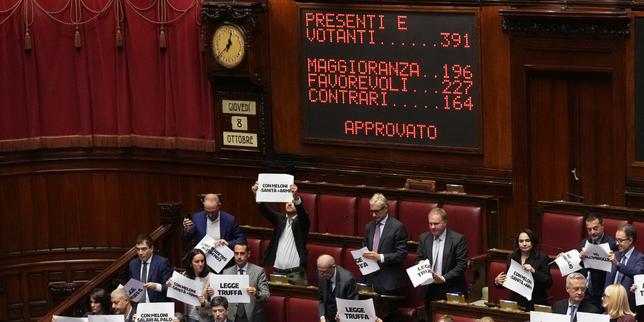
Italian Prime Minister Giorgia Meloni secured a definitive parliamentary victory in Rome, passing a controversial electoral overhaul designed to permanently alter how power is distributed in the Mediterranean republic. Pushed through the Chamber of Deputies following a tense sequence of legislative maneuvers and a secret ballot, the new statute replaces Italy's mixed voting system with a pure proportional framework anchored by a sweeping majority bonus. Under this legislation, any pre-declared coalition that crosses a 42 percent threshold of the national vote will automatically capture a commanding parliamentary majority.
To proponents within the Brothers of Italy party, the architecture represents a decisive strike against chronic governmental instability, forcing political factions to ally before ballots are cast rather than cutting backroom deals after the fact. To critics, from the Democratic Party to the Five Star Movement, it is an authoritarian maneuver engineered to manufacture artificial majorities out of fragmented pluralities.
Yet beneath the tactical celebrations in the ruling camp lies a more volatile reality. By tying her political survival directly to this legislative gamble, Meloni has constructed a high-stakes mechanism that could easily backfire before the nation returns to the polls.
The Anatomy of the 42 Percent Gamble
For decades, the Italian political landscape has operated as a graveyard for fragile cabinets. Prime ministers rise and fall on the whims of microscopic splinter groups, resulting in an average government lifespan that barely cracks twelve months. Meloni’s administration survived longer than most, largely due to personal political capital and an uncharacteristic baseline of party discipline within her right-wing coalition.
Realizing that continuity cannot rely on personality alone, her allies drafted the new law to force structural consolidation. The math is stark. If a coalition hits 42 percent of the aggregate vote, the electoral mechanics kick in to guarantee safe majorities in both the Chamber of Deputies and the Senate.
It sounds foolproof on paper. In practice, the 42 percent threshold is a razor-thin tightrope.
Consider a hypothetical scenario. If Meloni’s Brothers of Italy, Matteo Salvini’s League, and minor allied factions collectively stall at 40 percent because of voter fatigue or regional defections, the majority bonus evaporates. Worse yet, under the mathematics of the proportional allocation, a fragmented opposition bloc could slip into the driver's seat, inheriting the very institutional machinery built to protect the right.
The secret ballot utilized during the final parliamentary showdown revealed deep institutional anxiety. While the government held its ground with 227 votes in favor against 164 opposed, dissent within the broader conservative movement simmered away from the microphones. Backbenchers understand that fewer safe districts and shifting demographic preferences mean many incumbents will not survive the next candidate selection process.
Stripping Away the Safety Nets
The structural overhaul does more than redraw arithmetic formulas. It fundamentally alters representation dynamics, most notably by dismantling established gender quota protections.
Under the outgoing legal framework, strict statutory balances ensured that neither gender could dominate candidate lists or single-member designations, a safeguard that pushed female representation in the Italian parliament to roughly one-third of total seats. The new proportional model sweeps away those mandatory floors for top list positions, leaving gender representation largely at the mercy of internal party hierarchies.
Internal party estimates leaked to local press suggest female representation could plummet toward fifteen percent. For a government that frequently emphasizes modern governance while simultaneously advancing traditional social agendas, the quiet retreat from institutional quotas highlights a broader trend. Power is being centralized within party leadership circles, reducing the space for independent legislative voices.
This centralization compounds existing friction between coalition partners. The rise of independent nationalist figures and populist splinter groups threatens to siphon crucial percentage points away from the core governing parties. If right-leaning protest voters drift toward anti-establishment factions outside the official coalition umbrella, the magic 42 percent marker drifts entirely out of reach.
The Looming Constitutional Collision
The legislative battle in Rome has already shifted toward the courtroom. Opposition leaders have wasted no time declaring the statute an assault on constitutional checks and balances.
Italy's Constitutional Court has a history of striking down aggressive majority bonuses. Previous iterations of electoral engineering—such as the infamous laws that sought to manufacture artificial legislative stability—were ultimately clipped or dismantled by judicial review for distorting the proportional link between citizen votes and parliamentary seats.
Legal scholars argue that awarding an overwhelming legislative majority based on a 42 percent plurality violates the fundamental principle of proportional representation embedded in the nation's democratic tradition. If the high court accepts this line of reasoning, the entire legal edifice could collapse right as parties begin printing campaign materials for the upcoming general election cycle.
The timing could not be more delicate. Meloni’s administration already absorbed a stinging political defeat earlier this year when voters overwhelmingly rejected her broader judicial reform package during a national referendum. Stacking an electoral legal battle on top of that institutional friction creates a compounding vulnerability.
If the courts intervene, the prime minister faces a humiliating retreat, forced to rewrite the rules of engagement on terms dictated by her judicial critics and political enemies. If the courts uphold the law, she remains chained to a volatile percentage threshold that leaves zero margin for error.
The opposition is banking on internal exhaustion. They are betting that the right-wing coalition will fracture under the weight of its own internal ambitions before the ballot boxes even open. Meloni has staked her political legacy on the belief that institutional engineering can conquer Italian political volatility.
The machinery is built. The threshold is set. The countdown to the 2027 general election has become a high-stakes countdown toward either consolidation or collapse.
Italy's parliament approves Meloni's electoral reform
This video provides additional context on the parliamentary vote and the sharp reactions from opposition leaders regarding the electoral reform.