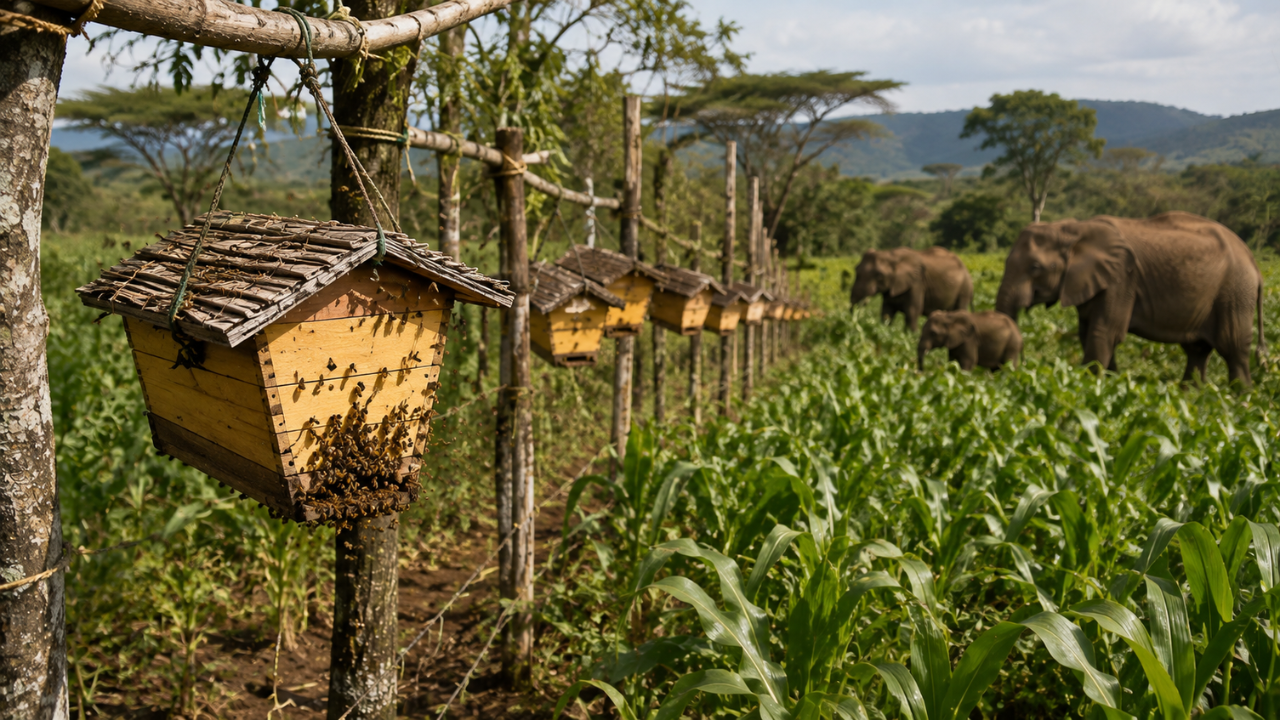
Elephants destroy farms in seconds. You can build concrete walls, dig massive trenches, or string up electric wiring, but a massive bull elephant will usually find a way through. Traditional barriers fail because wild animals are persistent, immensely strong, and deeply accustomed to navigating their historic migration corridors. Farmers lose entire harvests overnight. They face financial ruin and constant danger.
Then came the bees. Meanwhile, you can find related stories here: Stop Pretending Your Dog Understands Your Emotions They Just Want Your Cheese.
A landmark nine-year study conducted across Kenya changed how conservationists and agriculturalists view human-wildlife conflict. Researchers tracked 365 beehives deployed strategically around vulnerable farmlands. The results shattered expectations. It turns out that tiny insects provide a more effective shield against multi-ton mammals than any heavy machinery ever could.
If you think protecting crops requires expensive technology, you're missing the entire point of biological fencing. To see the full picture, check out the excellent article by Glamour.
The Biology Behind the Buzz
African elephants are terrified of honeybees. This isn't a quirky animal fact; it is an evolutionary survival mechanism. An elephant's skin is thick, but it has extremely sensitive areas around its trunk, eyes, and inside its mouth. When a swarm of angry bees attacks, they target these vulnerable spots. Stings inside the trunk cause immense pain and panic.
Dr. Lucy King and her research team understood this dynamic deeply. They designed beehive fences where hives hang from stout acacia trees or wooden posts, connected by simple wire systems. When an elephant brushes against the wire, the hives swing. The bees swarm instantly. The elephant retreats in panic.
It's brilliant. It works because it uses the animal's own instincts against it.
You don't need a degree in zoology to see why this approach succeeds where others fail. Concrete crumbles under pressure. Electric fences short out during the rainy season or get sabotaged by poachers stealing wire. Bees repair themselves, reproduce, and cost very little to maintain once established.
What the Nine-Year Kenya Study Actually Proved
Long-term ecological studies are rare. Funding dries up, researchers move on, or local political shifts disrupt the work. That's why the nine-year Kenyan agricultural study matters so much. It gathered data across multiple seasons, covering dry spells, heavy rains, shifting elephant migration patterns, and varying crop yields.
The data showed a success rate exceeding 80 percent in deterring crop-raiding elephants.
Let that sink in. Eight out of ten potential raids stopped dead in their tracks simply because an insect lived nearby.
Critics initially argued that elephants would quickly habituate to the bees. They thought the animals would learn that buzzing sounds don't always mean immediate pain. The long-year data proved the exact opposite. Elephants remembered the danger. Their social memory is phenomenal; matriarchs taught younger generations to steer clear of the swinging hives.
Farmers noticed other benefits too. Traditional pest control involves heavy chemical use or dangerous confrontations with wildlife. Beehive fences eliminated the need for overnight patrols where farmers sat in the cold and dark, banging drums or throwing firecrackers at charging beasts.
Secondary Revenue Streams Nobody Talks About
Farming is a gamble. Weather patterns shift unpredictably, soil degrades, and market prices fluctuate wildly. Relying on a single crop is financial suicide.
Beehive fences do more than just stop elephants. They produce honey.
Suddenly, a farmer struggling to protect maize or mangoes has a secondary cash crop. Local cooperatives began harvesting and selling high-grade organic honey, creating a micro-economy built around conservation. The bees also pollinate the very crops they protect, leading to higher yields per acre.
It is a closed-loop system. The fence pays for itself through honey sales. Crop loss drops dramatically. Farm income rises.
Compare that to electric fencing. An electric fence requires a constant power source, expensive solar panels or battery banks, and endless troubleshooting. It drains resources. Beehives generate resources.
Why Traditional Fences Keep Failing
Most agricultural development projects rely on top-down engineering. Governments or foreign aid agencies drop prefabricated metal fences into rural communities. Nobody trains the locals on repair. Maintenance budgets disappear. Within three years, the metal is rusted, the wire is stolen, and elephants are walking straight back into the fields.
Engineering solutions ignore human realities. People need tools they can manage themselves using local materials.
A beehive fence uses local timber, locally sourced wire, and indigenous bee species. If a post rots, a farmer cuts a new branch from a nearby tree. If a hive gets damaged, local beekeepers step in. This creates genuine ownership over the conservation process.
Wildlife management fails when it treats local communities as obstacles rather than partners. When you give a farmer a tool that generates profit while solving a massive security threat, protection becomes second nature.
Common Misconceptions About Bio-Fencing
People assume you can just drop a beehive anywhere and expect results. It takes precision.
Hives must be spaced carefully—usually about ten meters apart—with dummy hives interspersed to trick the elephants. If you place them too far apart, the animals find the gaps. If you place them incorrectly relative to the wind, the bees' scent doesn't deter the approaching wildlife.
Another mistake involves handling the bees themselves. You cannot treat an African honeybee like a domesticated pet. They are defensive and easily agitated. Farmers require proper training in apiculture. Without it, they get stung, abandon the hives, and write off the entire method as a failure.
Success requires patience. You have to wait for colonies to establish themselves. You cannot rush biology.
Setting Up Your Own Project
If you are looking at agricultural protection or conservation initiatives, stop thinking about physical barriers as dead weight. Think about living assets.
Start by assessing the local wildlife pressure. Map out elephant trails or pest routes before buying a single piece of equipment. Partner with local beekeeping associations rather than trying to import foreign methods. Train community leaders first. Ensure there is a ready market for the honey you plan to harvest, because sustainability depends on cash flow.
Do not wait for a government grant to pilot a small section on your property. Rig up a basic test line. Monitor the results over a single growing season. Adjust your spacing. Watch how local ecosystems react.
Protecting your livelihood doesn't mean waging war on nature. Sometimes it just means letting nature do the heavy lifting while you harvest the rewards.