Governments love photo ops with saplings. Hand a politician a shovel, put them in front of a desolate landscape, and watch them promise to reverse climate change by planting millions of trees.
It looks like progress. It makes for fantastic headlines. It is also an ecological catastrophe hiding in plain sight.
For decades, China’s mass tree-planting drives—most notably across the arid Loess Plateau—have been held up as the gold standard of environmental engineering. Millions of hectares of monoculture plantations were installed to anchor loose silt, stop desertification, and trap moisture. The narrative was clean, simple, and satisfying: man tames nature, trees save the dirt.
Except the data tells a completely different story.
An 18-year longitudinal monitoring study published in Water Resources Research tracked four distinct forest types across the Loess Plateau, comparing industrial plantations of Pinus tabuliformis (Chinese red pine), Platycladus orientalis (Chinese arborvitae), and Robinia pseudoacacia (black locust) against naturally regenerated secondary forests.
The results completely destroy the modern afforestation playback.
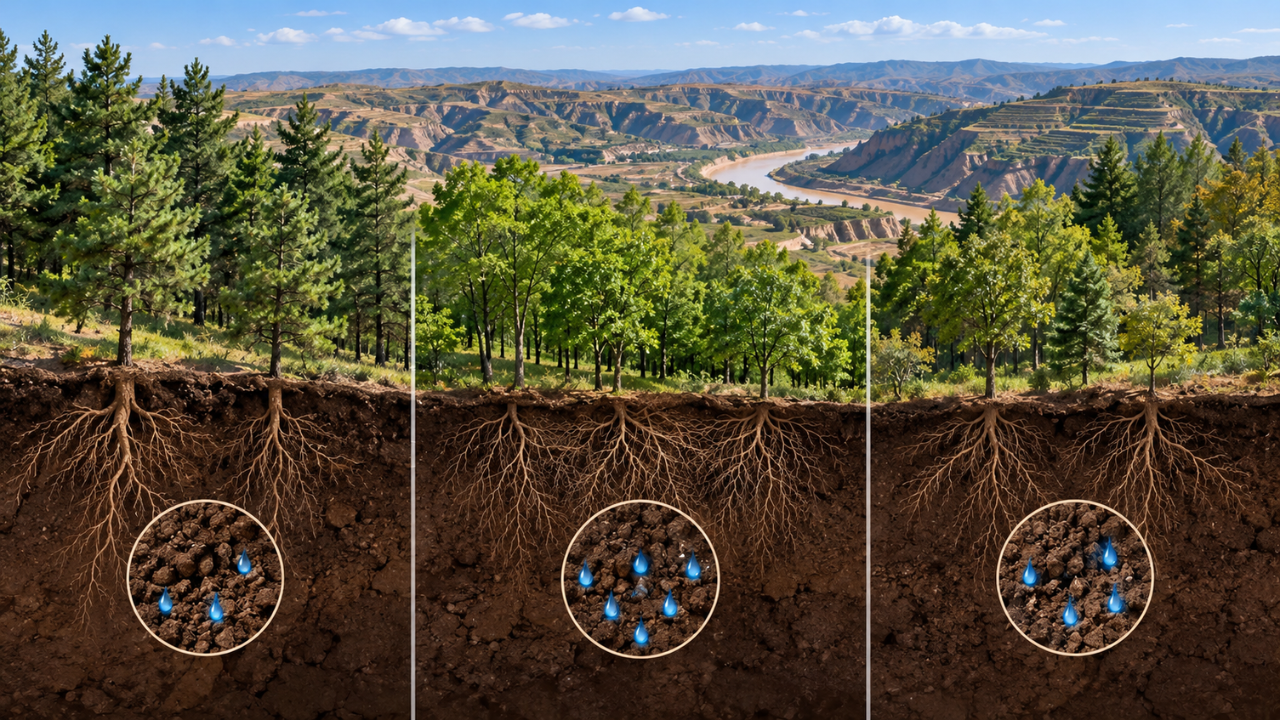
Naturally regenerated secondary forests held 8% more soil moisture than planted forests. They achieved 68.7% greater macroporosity, held 34.2% higher saturated hydraulic conductivity, and maintained an average soil water storage of 6 mm compared to a paltry 3 to 4 mm in the planted plots. While natural forests kept soil moisture stable for nearly two decades, moisture levels in planted plots of black locust and arborvitae cratered, creating underground "dry soil layers" that act as hydrological dead zones.
We have spent billions of dollars worldwide paying armies of workers to punch holes in fragile ecosystems, drop in non-native saplings, and pretend we are fixing the planet. What we are actually doing is installing high-volume biological water pumps that drain local aquifers and bake the soil dry.
The Monoculture Illusion: How Machine-Planted Trees Drain the Dirt
The fundamental flaw in modern environmental engineering is confusing greenery with ecosystem function.
When a government or corporate ESG board decides to plant a forest, they optimize for three metrics: speed of growth, survival rate of saplings in year one, and cost per hectare. That is how you end up with massive grids of single-species conifers or fast-growing invasive broadleaf trees like Robinia pseudoacacia.
These trees grow fast because they suck up immense amounts of water. In semi-arid regions like the Loess Plateau, precipitation is scarce. Fast-growing, densely packed plantation trees transpire water at rates far higher than native, self-seeded flora.
Instead of acting as a sponge, the planted forest acts as a siphon.
During the dry months between June and August, planted plots deplete water deep into the upper 60 centimeters of soil. The roots stretch down, greedily pulling every drop of groundwater to maintain their artificially forced canopy.
When torrential monsoon rains finally arrive, the soil under these plantations is so compacted and depleted of organic carbon that the water cannot penetrate. It bounces off the surface and runs off, carrying topsoil with it.
Natural secondary forests do the exact opposite. They do not grow in neat, uniform rows. They build intricate, messy root networks intermingled with native understory brush, decay matter, and fungal networks.
This diversity lowers soil bulk density to around 1.0 g/cm³ and creates high macroporosity—a massive network of micro-channels in the dirt. Rain does not wash over the surface; it vanishes into the ground, storing up to double the water volume of a manicured tree farm.
I have seen environmental consultants and corporate managers celebrate planting ten million trees in arid basins, completely ignoring that five years down the line, the deep soil moisture is lower than when they started. They built a biological desert wrapped in green leaves.
The Flawed Premise of Environmental Management
The prevailing dogma in climate tech and government policy is that human intervention must be active, aggressive, and industrial.
Why do we insist on planting trees when leaving the land alone produces superior hydrological resilience?
Because passive restoration does not generate photo ops. You cannot stage a ribbon-cutting ceremony around a patch of land where you simply fenced off livestock and let native weeds and shrubs naturally succession-plan their way back to health.
"Rewilding" or natural regeneration requires patience. It looks messy. Early-stage natural succession looks like abandoned, overgrown brushland, not a majestic, uniformly spaced pine forest.
Yet, that "messy" natural forest is secretly engineering a superior soil structure underground. It generates higher levels of soil organic carbon and total nitrogen, which bonds soil particles together into water-retaining aggregates.
Here is how the two approaches stack up over an 18-year timeline based on real-world hydrological monitoring:
| Metric / Outcome | Industrial Planted Plantation (Pinus / Robinia) | Natural Secondary Forest |
|---|---|---|
| Average Soil Water Storage | 3.0 – 4.0 mm | 6.0 mm |
| Soil Macroporosity | Low (0.047 – 0.089 mm³/mm³) | High (0.113 mm³/mm³) |
| Long-Term Moisture Trend | Severe decline, deep dry-soil layers | Stable, high retention |
| Saturated Hydraulic Conductivity | Poor infiltration, high runoff | +34.2% faster deep water intake |
| Understory & Root Diversity | Monoculture, low organic carbon | Complex bio-network, high carbon |
If your primary goal is carbon sequestration and soil stabilization that lasts longer than a political term, planting monoculture forests in dry climates is a complete failure of engineering.
Can We Fix Land Restoration Without Breaking the Water Table?
To be fair to the engineers who planned these massive afforestation projects decades ago, the initial crisis was real. The Loess Plateau was one of the most eroded landscapes on Earth, dumping billions of tons of silt into the Yellow River. Quick canopy cover was needed to stop topsoil from literally blowing away into dust storms.
Planted forests do anchor surface soil faster in years 1 through 5. If your hillside is actively sliding into a river, dropping fast-growing trees onto the slope acts as a structural band-aid.
The mistake is treating the band-aid as the permanent ecosystem.
Once surface erosion slows, those dense plantations must be thinned, managed, or systematically replaced with native broadleaf species and allowed to transition to natural secondary succession. Keeping a high-density conifer or black locust plantation on semi-arid land for 20 years guarantees you will starve the underlying water table.
Yet, almost no government forestry program plans for this transition phase. They declare victory once the saplings grow into trees, publish the acreage stats, and move on.
Stop Planting Trees. Start Fencing Off Land.
If you are a land manager, investor, or policymaker aiming to make a measurable, long-term impact on soil health, carbon capture, and water security, stop buying tree saplings in bulk.
Instead, execute a radical shift in strategy:
- Stop Monoculture Tree Drives: Ban single-species planting programs in semi-arid or water-stressed environments immediately. You are creating tomorrow's hydrological drought.
- Finance Passive Regeneration: Redirect capital away from nurseries and into land protection. Fence off degraded areas, eliminate grazing pressure, stop human disturbance, and let native seed banks re-establish naturally.
- Prioritize Soil Physics Over Canopy Cover: Stop measuring success by how green an aerial drone photograph looks. Measure macroporosity, bulk density, and upper-60cm soil moisture retention.
- Thin Existing Plantations: If you already own or manage dense tree plantations in dry zones, immediately thin the tree density by 30% to 50%. Allow native shrubs, grasses, and broadleaf understory species to fill the light gaps, restoring natural soil hydraulic processes.
We do not need to engineer nature with industrial efficiency. Nature already built the code for optimal water retention and soil health over millions of years.
Step out of the way, take the shovels away from the bureaucrats, and let the soil heal itself.